Court IQ · Players · Parents · Coaches
Basketball court explained.
Know every spot.
When the coach calls “fill the short corner!”, your player shouldn't have to think. Here's every spot and line on the court, named and explained to FIBA rules — with a quiz for the drive home.
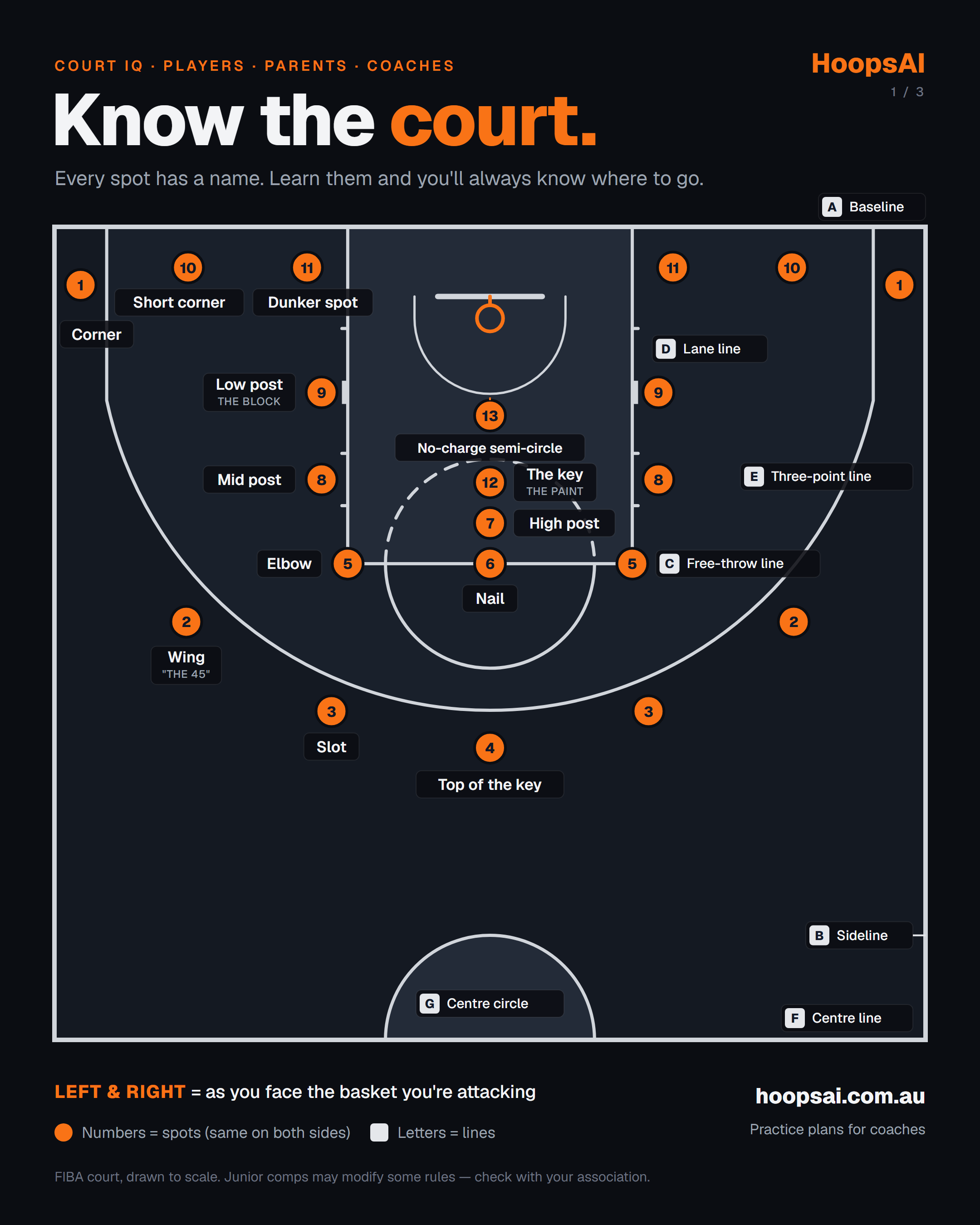
Left and right are as you face the basket you're attacking. Numbers are the same on both sides. Tap the diagram to open it full size.
The spots
Spots are coaching names, not rulebook terms, so coaches vary a little. These are the most common uses in Australia.
- 1
Corner
Behind the three-point line, right down near the baseline.
The shortest three on the court: 6.60 m from the basket, against 6.75 m at the top.
- 2
Wing“the 45”
On the three-point arc, about level with the free-throw line, at roughly 45° to the basket.
Most offences start with players filling both wings.
- 3
Slot
On the arc, between the wing and the top of the key.
A natural gap between defenders, so it’s a good place to drive from.
- 4
Top of the key
On the arc, straight out from the basket.
Where the point guard usually starts the offence.
- 5
Elbow
The corner where the free-throw line meets the side of the key. There’s a left elbow and a right elbow.
A prime spot for catch-and-shoot jumpers and for setting screens.
- 6
Nail
The middle of the free-throw line. Many courts have a small mark there.
Defenders “help at the nail” to stop drives through the middle.
- 7
High post
The area around the free-throw line, at the top of the key.
A player here can shoot, pass or hand off — the link between the outside and inside players.
- 8
Mid post
On the side of the key, halfway between the block and the elbow.
A spot for post players to catch the ball and face up to the basket.
- 9
Low post“the block”
On the side of the key, closest to the baseline, beside the small solid block painted on the line.
Where post players set up with their back to the basket.
- 10
Short corner
On the baseline between the key and the corner, inside the three-point line.
A player here sits behind a zone defence and pulls it apart.
- 11
Dunker spot
On the baseline, just outside the side of the key.
Wait here when a teammate drives: their defender has to choose between them and you.
- 12
The key“the paint”
The painted rectangle in front of the basket, 4.90 m wide and 5.80 m long.
Attackers can’t stay in it for more than 3 seconds at a time.
- 13
No-charge semi-circle
The small arc right under the basket, 1.30 m out from the centre of the ring.
A defender standing in it usually can’t draw a charge on a player driving to the basket.
Terminology trap
The FIBA rulebook calls the key the “restricted area”. In American basketball, “restricted area” means the small no-charge arc under the ring. To avoid confusion, we say “the key” and “no-charge semi-circle”.
The lines
Baseline
The line behind each basket, also called the endline. The line itself is out of bounds.
Sideline
The two long lines down each side of the court. The line itself is out of bounds.
Free-throw line
The short line at the top of the key, 5.80 m from the baseline (about 4.60 m from the backboard).
Lane lines
The two long sides of the key. Players stand in the marked spaces along them during free throws.
Three-point line
The arc, 6.75 m from the basket at the top and 6.60 m in the corners. Both feet must be behind it for three points — a foot on the line makes it two.
Centre line
Splits the court in half. Get the ball over it within 8 seconds; once your team has it in the frontcourt, it can’t take the ball back over.
Centre circle
The circle in the middle (1.80 m radius), where the opening jump ball happens.
Rules that go with the spots
- Three seconds
- An attacking player can’t stay in the key for more than 3 seconds in a row while their team has the ball in the frontcourt. The lines count as part of the key, and both feet have to be outside it to reset the count.
- Eight seconds
- The team with the ball has 8 seconds to get it from the backcourt into the frontcourt.
- Backcourt
- Once your team has the ball in the frontcourt, your team can’t be the one to send it back over the centre line.
- Out of bounds
- The boundary lines are out. Step on the baseline or sideline while holding the ball, or let the ball touch the line, and it’s the other team’s ball.
Junior comps sometimes modify these rules (for example, banning zone defence). Check your association's rules.
Words coaches use all the time
Left / right
Always as you face the basket you’re attacking.
Strong sideor ball side
The half of the court where the ball is.
Weak sideor help side
The half without the ball. Defenders here “help” on drives.
Frontcourt / backcourt
The half you’re attacking, and the half you’re defending.
For parents
The five-minute driveway quiz
Ask these on the way to practice. Tap a question to see the answer.
01“Point to the left elbow.”
Left as you face the basket — not left as you look at the court from the stands.
02“Your teammate drives from the wing. You’re on the baseline. Where do you go?”
The dunker spot, just outside the key.
03“What’s the difference between the slot and the wing?”
Both are on the arc. The wing is level with the free-throw line; the slot is between the wing and the top.
04“Your foot’s on the three-point line when you shoot. How many points?”
Two. Both feet have to be behind the line.
05“Where’s the nail, and why do defenders care about it?”
The middle of the free-throw line. It’s where help defenders stop drives.
Free PDF
Coaches: send this to your team
Get the court diagram, every spot explained and the parent quiz as a 3-page PDF. Drop it in your team chat so every player and parent learns the same names.
Email me the PDF
We'll send it straight to your inbox.
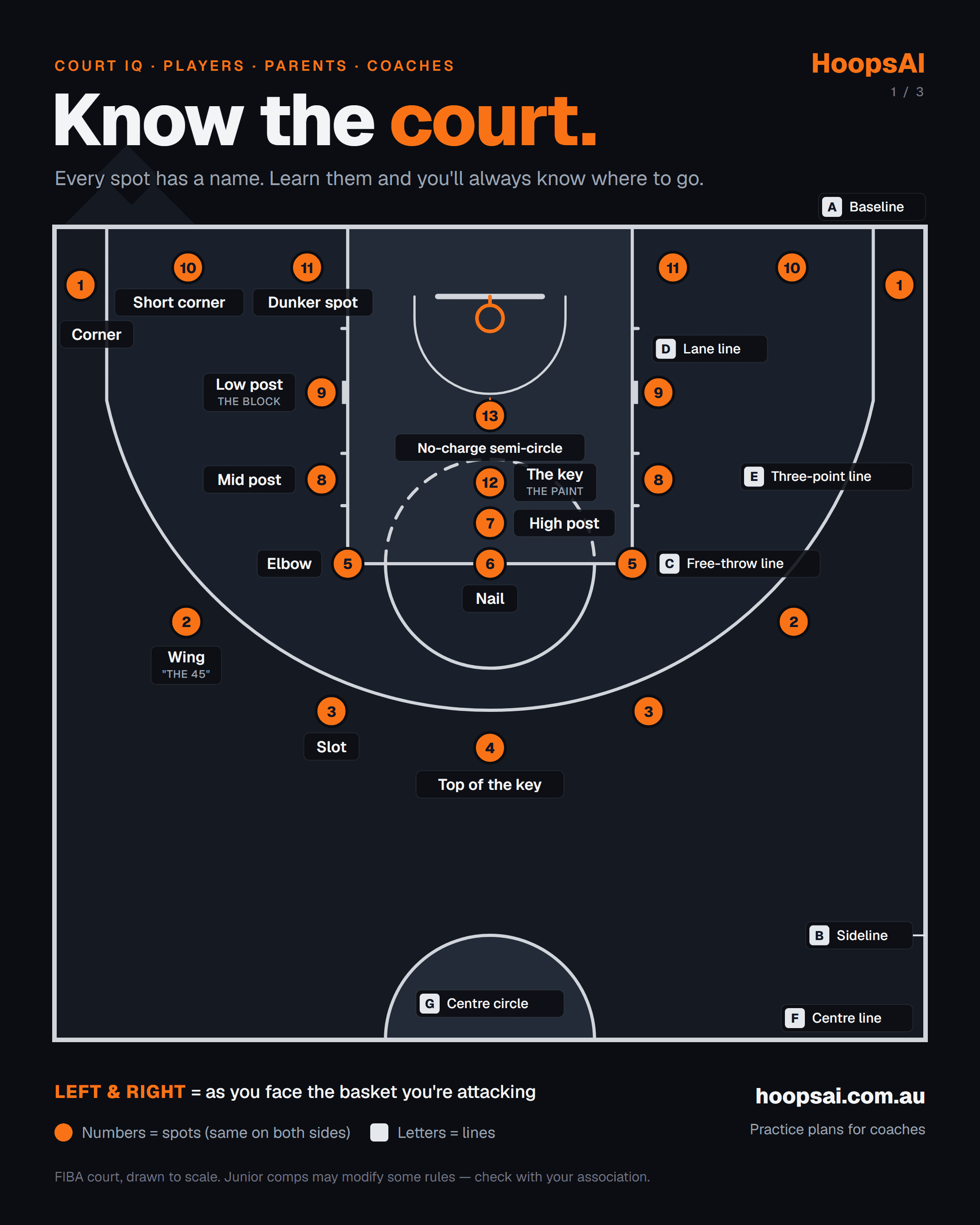
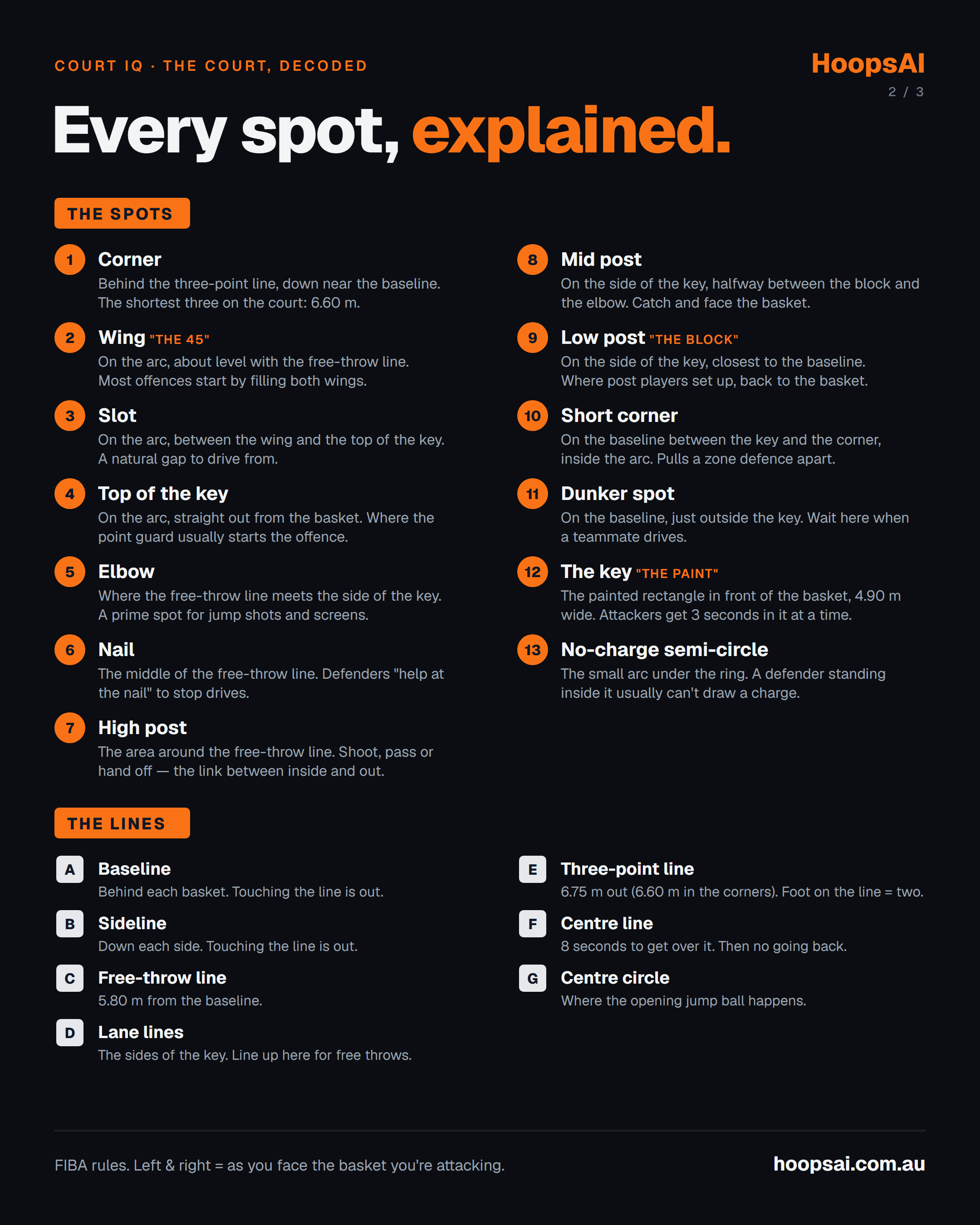
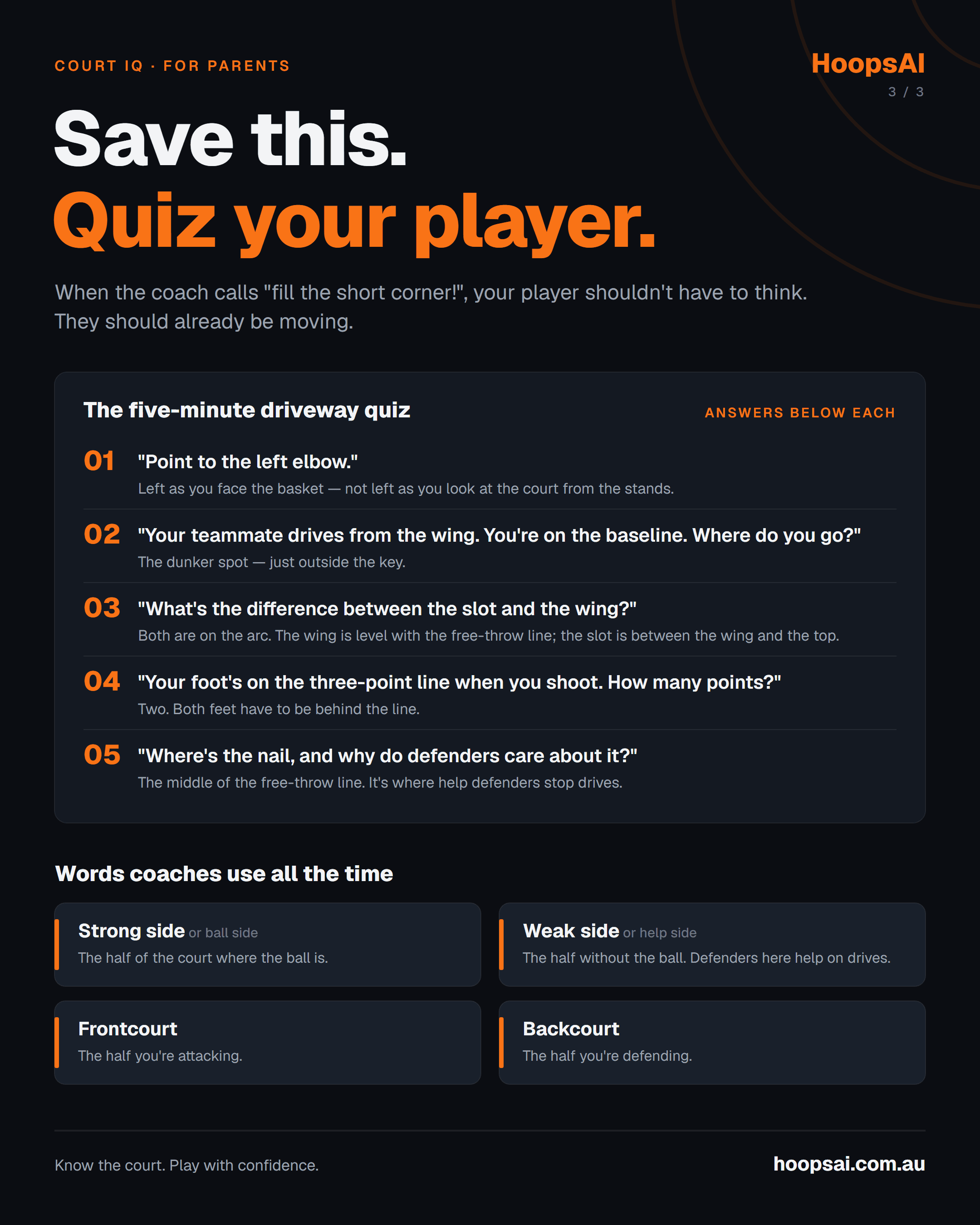
Players who know the court run better drills
Once everyone knows where the elbow and the short corner are, you spend less time explaining and more time playing. HoopsAI builds complete, timed practice plans for your team.
Court dimensions and rules checked against the FIBA Official Basketball Rules 2026.